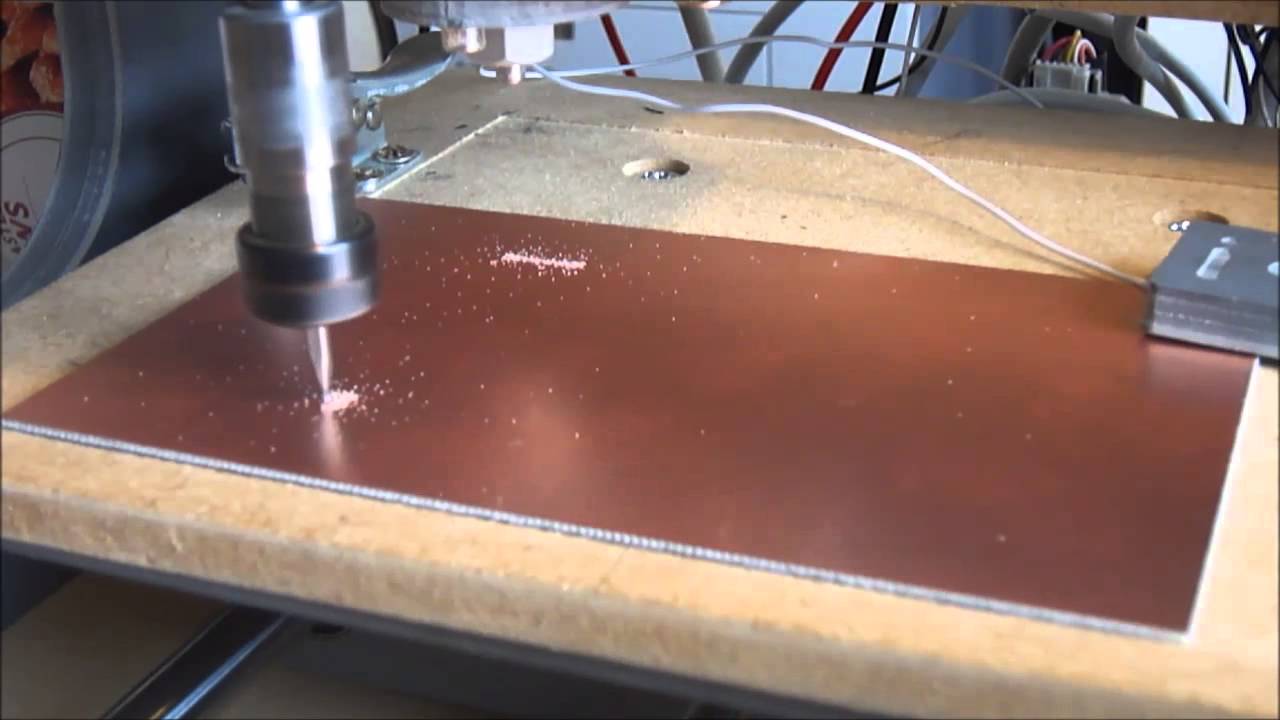
I had the opportunity to test print some pcbs this weekend on the PCB mill.
Does the controller (Parallel port?) have the capability to introduce a ‘probing circuit’ for using this auto-leveling software? This involves connecting an alligator clip to the tool and to a pin on the controller.
I THINK the controller could do all of that, but I’m not 100% positive. I THINK it has enough lines for adding machine limits on each axis for instance, which we don’t currently have setup.
I’ve seen this approach before, but I had never seen someone share the software (this code basically loads the G-code then edits it all by adjusting Z based upon a height map it collects).
I added a Z axis touch off to Kenny (the EMCO mill) and it uses Linux CNC so I can see what they are doing in the video. It would probably need some kind of macro or a separate program that runs through the g-code and adjusts the height based on the position, but I think this is overkill. I’ve never used the PCB mill but the process is virtually the same as the EMCO. Normally, I face the work piece and that ensures a level surface to the milling tools. You wouldn’t do that with a copper clad board but if there is any doubt that you have a flat surface it might be better to just run the program twice. The first cut would be very shallow and that would ensure the surface is level to the milling bit at the cutting pattern. This is essentially the same as facing but only in the pattern. The second run would then be to the proper depth. So this adds time in using a second run but the autolevel program you’ve found takes 80 points to create the level map. No matter how you look at it, it’s going to take extra time. Anyway, my only point is that the path of least resistance is to do multiple runs.
I think the reason people like to get the height perfect is that people are using engraving bits (like the ~30 degree bit in the video) instead of endmills (like 0.5mm endmills) for PCBs. Depth of cut affects width of cut on those type of cutting bits big time, so the height is super sensitive.
The engraving bits are a lot less likely to break than a 0.5mm endmill. So I think feeds and speeds could be higher for engraving bits. Of course the increase in speed might be nullified by probing etc.