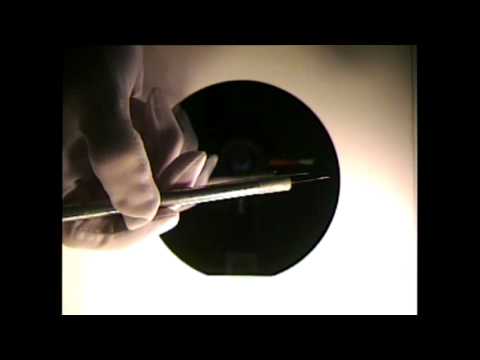
I need to cut a silicon wafer into smaller pieces. I do not need semiconductor precision but I do want to cut it to a specific rectangular size.
Back when the cavemen made semiconductors the process would have involved scoring it and then rolling over it to separate the scored pieces. It is obviously brittle so that limits what can be done.
I assume at this point you’re pretty good with a Dremel, they have diamond blades that might just let you cut it out like any other material.
I’m not familiar with the scoring method, but it might be dependent on the idea that most dies are much smaller than the parent wafer - they’ll essentially be rigid while the wafer will deflect slightly more. Not sure how well it works if your rectangle approaches the size of the wafer. Also, you may not have the benefit of less metal between wafers, forming another natural weak area.
Semiconductors use either diamond saw or maho lasers these days. My question is whether the wafer has already had backgrind applied (basically made thinner). If so it probably would shatter. Typically the water in the factory is placed on a semi sticky material to help support the water during dicing so you may want to consider that as well.
I would suggest using the Nd:YAG Laser, but we don’t have one at The Space. I do happen to have a 20W Spectra Physics 940nm fibre coupled Laser, but it’s on mothballs in my garage–maybe it’s time to bring it out…
You don’t need any special tools if you break it it will fracture along crystal length, its called a cleavage plane, you do not need a dremel, pen knife would be fine.
Science Committe has a number of SIlicon Wafers already, ( I don’t know what crystal orientation) but you could probably ask the current chair @FairieCyanide to buy one from the committee for $10-15 bucks.
If the wafer has been processed with die destined for a dicing (cutting), the area in between the die generally hold electrical test structures (we would called it the scribe) and are specifically designed with the sawing process in mind. So if it is a processed wafer, ideally one would cut in the middle of the scribe (which we call the street).